CPJ calls on the legislature to remove criminal defamation provisions from its penal code after a Supreme Court decision eliminated prison terms from the Printing Press Law.
(CPJ/IFEX) – New York, February 12, 2010 – The Committee to Protect Journalists today called on the Costa Rican legislature to remove criminal defamation provisions from its penal code after a recent Supreme Court decision eliminated prison terms from its 1902 Printing Press Law.
The provisions were eliminated from the Printing Press Law – known as Ley de Imprenta – which imposed prison sentences of up to 120 days for defamation in print media.
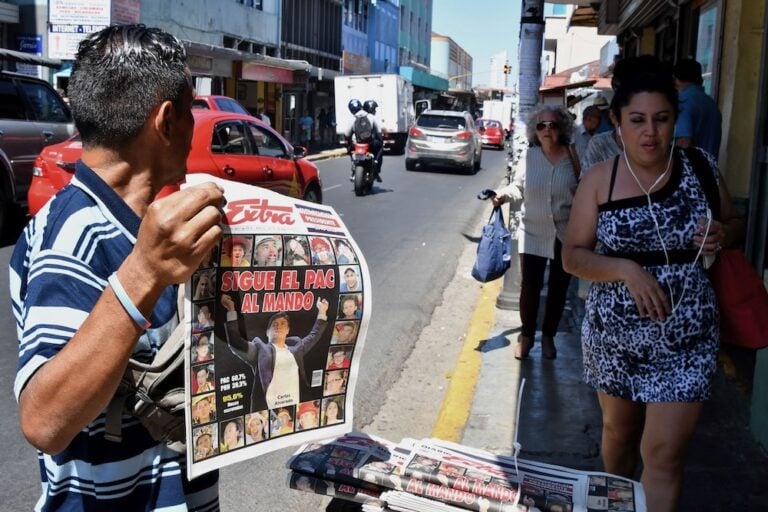
The court made the ruling while it was reviewing a defamation case against José Luis Jiménez Robleto, a reporter with the San José-daily Diario Extra, according to local news reports. Jiménez had been accused by a former Costa Rican official after publishing a news story on alleged embezzlement, the press reported. The journalist was sentenced in March 2004 to 50 days in prison based on the outdated 1902 press law. His conviction was overturned by the Supreme Court.
The court’s decision about the press law, issued on December 18, was made public this week. Costa Rican journalists said it was a victory for freedom of the press. The daily La Nación described it as “historic.” The paper’s editor, Armando González, said that the court set an important precedent.
Under Costa Rica’s Penal Code, anyone who libels, slanders, defames, or reproduces offensive statements against someone, even public officials, can be fined or placed on an official list of convicted criminals, but not imprisoned, CPJ research has found.
“We consider the Supreme Court’s decision an important step forward toward what we hope will be the total elimination of criminal defamation in Costa Rica,” said Carlos Lauría, CPJ senior program coordinator for the Americas. “We now urge Costa Rica’s legislative assembly to eliminate defamation provisions from its Penal Code.”
Laws that criminalize speech are incompatible with the rights established under Article 13 of the American Convention on Human Rights, which Costa Rica has ratified. As the Inter-American Commission on Human Rights stated in 1994: “Considering the consequences of criminal sanctions and the inevitable chilling effect they have on freedom of expression, criminalization of speech can only apply in those exceptional circumstances when there is an obvious and direct threat of lawless violence.”
There is growing international consensus that journalists should not be jailed for criminal defamation. In November, the Argentine Congress repealed criminal defamation provisions in the penal code. In April 2009, Brazil’s Supreme Federal Tribunal annulled the 1967 Press Law, a measure that had imposed harsh penalties for libel and slander.